
NGINX Rift
An 18-year-old heap buffer overflow in NGINX's rewrite module enabling unauthenticated remote code execution.
Understanding the Threat
Discovered: May 2026 (Autonomous AI discovery)
Researcher: DepthFirst Security Analysis System
NGINX Rift is a critical heap buffer overflow in NGINX's ngx_http_rewrite_module that has existed since 2008 — 18 years of vulnerable servers. The vulnerability enables unauthenticated remote code execution (RCE).
This is not a theoretical vulnerability. A fully working public exploit exists and has been tested on default NGINX installations. Any server running NGINX with rewrite rules is potentially vulnerable.
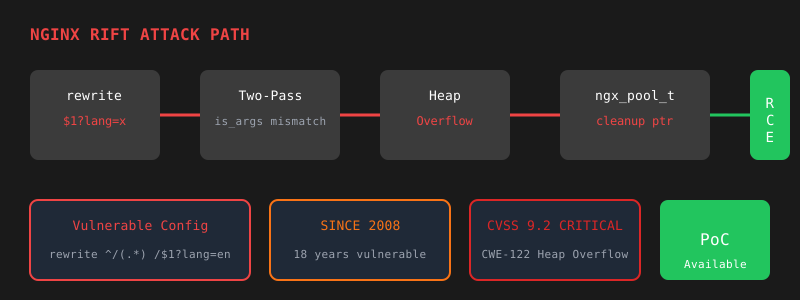
🚨 Why This Matters
- Unauthenticated RCE — No login required, network-accessible exploit
- Since 2008 — Eighteen years of affected NGINX installations
- Default configurations vulnerable — Any server using rewrite or set directives
- Public PoC available — Actively exploited in the wild
- AI-discovered — First vulnerability found autonomously by AI security system
Am I Vulnerable?
If your NGINX server uses the rewrite or set directives with PCRE captures (like $1, $2) in replacement strings containing a question mark, you are vulnerable.
The vulnerability is triggered when a rewrite rule uses a PCRE capture variable ($1, $2, etc.) in the replacement string AND that replacement string contains a question mark. Common examples include redirect rules and URL normalized patterns.
Vulnerable Configurations
The following patterns are commonly used and ARE vulnerable:
# Vulnerable: rewrite with $1 and ? in replacement
rewrite ^/(.*) /$1?lang=en redirect;

# Vulnerable: set with PCRE capture + ?
set $new_uri $1?mode=debug;

# Vulnerable: rewrite followed by if using capture
rewrite ^/old/(.*) /new/$1;
if ($uri ~ /debug/(.*)) {
  set $id $1?ref=header;
}These patterns do NOT trigger the vulnerability (no question mark in replacement):
# Safe: no ? in replacement
rewrite ^/(.*) /$1 redirect;

# Safe: static replacement only
rewrite ^/old /new permanent;

# Safe: no PCRE captures
rewrite ^ /index.html redirect;
Affected Versions
| Product | Affected Versions | Fixed Version |
|---|---|---|
| NGINX Open Source | 0.6.27 – 1.30.0 | 1.31.0 or 1.30.1 |
| NGINX Plus | R32 – R36 | R36 P4, R35 P2, R32 P6 |
Check your version: nginx -v
Technical Details
The vulnerability exists in NGINX's two-pass script engine processing:
- Length pass — First calculates buffer size needed for the rewrite result
- Copy pass — Then allocates and copies data to the buffer
When a rewrite replacement contains "?", the is_args flag is set on the main engine. However, the length-calculation pass runs on a freshly zeroed sub-engine where is_args = 0. This causes:
- Length pass: Returns raw capture length (is_args = 0)
- Copy pass: Calls ngx_escape_uri with NGX_ESCAPE_ARGS, expanding to 3x (is_args = 1)
- Result: Heap buffer overflow with attacker-controlled data
Attackers use cross-request heap feng shui to place a controllable ngx_pool_t cleanup pointer adjacent to the overflow, then corrupt it to redirect to a fake cleanup structure that invokes system() when the pool is destroyed.
How to Fix
1Upgrade NGINX
The primary fix is to upgrade to a patched version. Most package managers have the update available.
sudo apt update && sudo apt upgrade nginxsudo dnf update nginxsudo dnf update nginxdocker pull nginx:1.312Workaround: Disable PCRE in NGINX Config
If you cannot upgrade immediately, modify your rewrite rules to avoid the vulnerable pattern:
# Before (Vulnerable):
rewrite ^/(.*) /$1?lang=en redirect;

# After (Safe) - Use named capture:
rewrite ^/(?<capt>.*) /${capt}?lang=en redirect;
# OR
rewrite ^ /redirect.php?url=$1 permanent;
Note: The workaround may change behavior. Test thoroughly before deployment.
3WAF / Rate Limiting Mitigation
While not a complete fix, rate limiting can reduce exploit attempts:
limit_req_zone $binary_remote_addr zone=default:10m rate=10r/s;

server {
  limit_req zone=default burst=20 nodelay;
}
Critical: NGINX Plus Customers
NGINX Plus customers must upgrade through F5 BIG-IP or download patches from F5 Downloads. The open source package update may not apply to NGINX Plus installations. Contact F5 support for patch access.
Download & Test PoC
The official proof-of-concept is available from DepthFirst. Use only for authorized testing.
git clone https://github.com/DepthFirstDisclosures/Nginx-Rift.git
cd Nginx-Rift
./setup.sh
python3 poc.py --target http://your-nginx-server
Disclosure Timeline
Resources
- NVD CVE-2026-42945
- depthfirst.com/nginx-rift — Official vulnerability site
- GitHub PoC
- Technical Writeup
- F5 Networks Advisory
- NGINX Changelog